Got libgourou working (link to follow), with thanks to simont for bringing it to my attention and me_and for making sympathetic and encouraging noises while I stared muzzily at the documentation this evening. Happy to report that I have successfully downloaded Adobe DRMed ebooks from my command line without any Windows install or emulators at all.
I am enjoying A Physical Education so much - SO much - that I have gone out and bought a book it recommends (Starting Strength; very wordy descriptions of which muscles one should be using for what, apparently, i.e. exactly my kind of thing). Acquiring my own copy once I've given the library's back is a definite possibility. It's really interesting in terms of both the pain Project (memoir about embodiment!) and in terms of my own movement-related special interests (e.g. the gulf between my experience of largely self-led Pilates vs the version available via mainstream contemporary classes embedded in diet culture). Lots of content notes but I'm really really liking it. Gratitude to buttonsbeadslace for posting about it (... link to follow...)
Stupid Little Walk yielded both very cheap pistachio croissants (MORE BREAKFAST NONSENSE) and a very cheap "cinnamon danish with vanilla fondant icing" I've been vaguely eyeing up but was also very suspicious of. I am glad to have tried it and probably won't get it again, even if it is only 19p.
This evening's tofu was particularly cooperative with being cooked. (Thanks be to evilsusan for the specific combination of courgettes, tofu and garlic that I still make regularly lo these many years later )
I hit refresh on Oxfam Online and discovered that the rotating sale has migrated back around to "30% off 3+ books". Thus now on their way to me I have: the first edition of Explain Pain for an astonishingly reasonable price (I want to do the deeply nerdy thing of a side-by-side comparison with the second edition, and also to revisit its structure while the second edition is on loan to a physio friend...); a book entitled Science of Pilates, which I'd previously eyed up but that time it sold before I got around to it; a book about allotments and cooking; and a probably questionable out-of-print 1980s cookbook...
Feeling wearied ten years ago by the effort of coming up with posts here might not have afflicted me for all that long. Before that mood lifted, though, it did turn into the motivation to sign up for Tumblr and start posting “computer magazine covers” cadged from the Internet Archive and a few other sources. Not that long after I’d started, so it now seems, efforts to clean that service up injured it, and yet there are still other people posting there and operating on a lower key might make it feel a little less reprehensible than some other services.
To push towards the ten-year mark I did resort to posting covers from some computer magazines I hadn’t quite accumulated scanned copies of back when starting. I do feel as if I’m closer to the end than the beginning of that second pass through history. At this point, aware of the certain amount of time that goes into “skimming a magazine and putting together a capsule description to go with the cover” and how I keep feeling like I’m short on time after work these days, I’m contemplating whether I have enough content to just go on to reposting covers from “fifty years ago,” “forty-five years ago,” “forty years ago,” and so on; it might even amount to “a post every day of the month.”
Now that the weather is on the turn, sort of more or less because March is seriously not to be trusted, I ventured out past Bathurst yesterday to Sushi on Bloor. Possibly the staff remember me even after two months, or possibly they rush to open the doors for all ancient walker-users, but I choose to believe the former and think it very nice of them. Had salmon teriyaki instead of sushi for the omega-whatevers, even though salmon is always iffy for me. Of course I then had Bailey's and vodka after I came home and suffered heartburn all night, which will learn me. But the salmon skin didn't help, of course.
Glorious sun today and temps above freezing so I hacked my garbage bin out of its snowy bed and replaced it with the recycle. Thus I needn't get out to Shoppers for garbage tags as I'd feared I might have to. I still don't have that much garbage, even though I haven't put it out since the first week in January. My green bin is still firmly stuck in the snow and will doubtless stay that way for a few weeks yet, because I still can't get anywhere near it. Things will melt tomorrow and then flash freeze on Sunday. Must keep the salt handy and possibly buy more, since All That Snow will melt onto the sidewalk--is melting already-- and then flash freeze into a skating rink.
To note in the current game of Recycle Bingo: recycle was picked up yesterday morning, so one must indeed put it out the night before and not bank on a late pickup. Except that the block south of me was still out at 4:30, on the western side, while the east had already been done.
Am wondering about a point of wedding etiquette. Suppose I send my nephew and his fiancée a cheque in lieu of a wedding present. Who do I make the cheque out to? I don't know if they have a joint account, I don't want to send it to just my nephew-- whom I haven't seen in 30 years anyway-- and I don't know if my instinct to send separate but equal cheques to each is permissable. Shall consult the s-i-l, I suppose.
Yu know the world situation, which adds its mite ( for definitions of "mite,"watch out for falling pianos) to the stress closer by. The worst of it is feeling helpless to do much besides donate money to the outer stresses and listen as I can to the inner. Which I have been doing, in spite of our income dwindling. But this is a common plight.
My brain did go into revolt, and a bit of OT3 fantasy comedy of manners unspooled itself over the past month and a half or so. I wouldn't mind that happening again because it keeps me busy--besides various books and TV shows. But none of those have lit my fire quite as much as having a brainmovie again.
I do have Katherine Arden's latest here, and it looks good. But it's called The Unicorn Hunters and appears to be based on the tapestries so splendidly displayed in New York. Very handsome tapestries, but whew. Those boys strutting their tight breeches and little short jackets and perfect hair were a bunch of brutes. The tapestries illustrate an exercise in human cruelty, and the news is kind of overflowing with that, so I'm waiting for the right mood for the book.
II've done some rereads, and some new reads, I continue to listen to audiobooks while trudging my daily steps.
Oh! edited to add: I watched the Plympics ice skating and ice dancing. Some really lovely stuff, though they do seem to be obsessed with the quad spin.
Now that I know lots more about robots than I used to, I can tell you that humanoid is maybe the worst shape for a robot. If you don't believe me, watch some videos from the Consumer Electronics Show. They fall down all the time. Sometimes, as with Elon Musk's robots, they are just guys in suits and not robots at all. Humanoid is a bad shape for a human (this observation brought to you by how much my back is currently killing me) so why not make a robot that is shaped like basically anything else?
(I mean you know the answer is slavery, right? It's always slavery.)
Anyway this episode is weirdly fun to listen to because we're talking about something that is basically impossible and can't replace people, vs. AI which is basically impossible but will replace people because of all the middle managers who've had frontal lobotomies.
This week, time for something a bit silly: we’re going to think about the plausibility of the warfare in Frank Herbert’s Dune! In particular, I want to approach the question in two parts: first asking if the model of warfare among the Great Houses we’re introduced to in the first book of Dune (that is, in the first third of the book) makes sense given the fantastical technology and social structures Herbert has created to enable it. Then, next time, we’re going to return to ask, given that model of warfare, if the success of the Fremen jihad, occurring in the space between Dune and Dune Messiah actually seems plausible. Could a military society like Dune‘s Great Houses exist given their technology and if they did, could the Fremen have conquered them?
I should note here that while I am going to use a few images from the recent film adaptations, I want to focus here strictly on the combat model as presented in the books. Villeneuve’s film adaptation gets closest to replicating Herbert’s system of warfare – the other adaptations succumb to the temptation of simply introducing lots of guns of one kind of another – but there’s enough small changes or variations that I want to stick just to the books and the ‘pure’ expression of Herbert’s vision of futuristic warfare.
But first, as we’re going to cover below, equipping a fighting force with Dune’s version of modern military power – shields, ornithopters and frigates – is expensive. If you want to help me equip a Great House of trained fighters to challenge the Imperium, you can support this project over at Patreon. If you want updates whenever a new post appears or want to hear my more bite-sized musings on history, security affairs and current events, you can follow me on Bluesky (@bretdevereaux.bsky.social). I am also active on Threads (bretdevereaux) and maintain a de minimis presence on Twitter (@bretdevereaux).
Warfare Under Shields
Of course for those who know books (and at least the Villeneuve film), the fundamental technology shaping warfare among the Great Houses of Dune is shields. This is a production of the fictional ‘Holtzman effect’ which is the (again, fictional) physics principle in the Dune universe which enables the folding of space for faster-than-light travel (but not the safe navigation thereof), ‘suspensors’ that allow objects and people to be levitated and finally the operation of energy shields which would repel any object attempting to pass through above a certain minimal speed.
From Villeneuve’s recent adaptation Dune (2021), Duncan Idaho activating his body shield and charging into battle. While it isn’t perfect (what adaptation is?), one thing I very much liked about Villeneuve’s adaptation is that he tried a lot harder to capture the fighting system described in the books and largely succeeded.
Now I’ll note that Herbert’s physics here is actually a bit dodgy. We’re told that the reason for the minimal speed is to allow air-flow into and out of the shield, but my understanding is that even in room temperature air that feels quite still to us, the individual gas molecules move very fast (something like c. 450m/s), so a velocity-lower-limit wouldn’t work effectively as a ‘filter’ to let in air but not, say, bullets. But I am prepared to just accept that the shields work the way they are described, permitting slow-moving objects (and also air, for some reason) but repelling faster moving objects.
Of course in a way, the reason shields work this way in Dune is that it produces the fighting system that Herbert wants: shields effectively nullify missile weapons and explosives of all types, leading to a return to contact weapons, particularly knives. That has all sorts of knock-on effects on the structure of armies in this universe which we’ll get to below, but let us stay focused here on individual combat. We’re repeatedly told that the fighting style that results from this near-total emphasis on shields is unusual and to a degree artificial, demanding combatants keep their offensive movements slow enough to penetrate a shield.
So we might first ask if this fighting system, at the individual level, makes sense given the fantastical constraints Herbert’s shields impose. And I guess my answer is…sort of? I think the idea of a return to contact weaponry in this context works in the main, but with two main exceptions, which is that the style of contact weapon fighting that dominates is not what I would anticipate and second that the way Herbert also excludes laser weaponry strikes me as perhaps not fully thought out.
When it comes to style it is important to separate the various film adaptations – particularly Villeneuve’s (which features a lot of armor) – from the books. In the books, the strong impression is that body armor is not a typical supplement for shields: we never hear about heavy armor and instead hear about shields being attached to fabric uniforms (such as when Duke Leto’s uniform is torn where the shield attachment was ripped off). Meanwhile, the contact weapons of choice seem almost invariably to be short blades, described as daggers or knives. The most common weapon of the Great Houses was the Kindjal and it is described as having a 20cm blade, which is quite short, very much a dagger rather than a sword (the smallest of swords generally still have blade-lengths upwards of 45cm).
That is great for producing lots of cool, dramatic knife fights, but honestly doesn’t make much sense to me given the constraints. The main factor in the decline of body armor was, quite famously, the fact that it became increasingly impossible to armor against firearms without massively thick armor that was impractically heavy. But shields remove this problem: the velocity (and thus energy delivery) of any strike is now strictly limited, meaning even relatively thin and light armor will be effective. Under those conditions, a combatant wearing armor could render most of their body’s surfaces functionally immune to contact weapons without a serious loss of agility, forcing an opponent to aim only for things like joints that cannot be armored easily with solid (if articulating) plates. Whatever agility is lost would be more than offset by being able to target all of an opponent’s body while only offering a tiny portion of your own in response.
Armor from Villeneuve’s adaptation of Dune. Such heavy armor isn’t really mentioned in the books, but I think makes a very logistical addition to the warfare described.
People in Dune are often super-humanly intelligent, fast and agile, but they do not appear to be super-humanly strong to the point that they’d be able to, say, drive a knife through a millimeter of steel (or whatever exotic science fiction equivalent might be furnished). In short, I would expect armor to dominate formal combat in things like open battles or duels where fighters had time to put it on.
That in turn is going to mean that combat is going to consist of a lot of grappling, because to actually get a weapon through the relatively small gaps offered by that armor – or for that matter to slide a dagger at relatively low speed through a shield – it is going to often be necessary to get an opponent on the ground and to some degree pinned. Knives would be useful in that context, but speaking historically so would many polearms, designed for hooking and levering attacks that do indeed occur at speeds sufficiently slow to function through shields, in order to throw opponents to the ground. Alternately if for some reason body armor does remain rare, then the obvious optimal choice for combat is the spear, given the tremendous advantage that reach poses and the fact that a spear’s pin-point piercing attack has no problem penetrating a target even at low speeds.
The related problem is the relative lack of formation fighting. Now I want to be clear, there is some formation fighting in the books, particularly the note that the Sardaukar can be recognized in combat because they split into groups of three fighting in a triangle back-to-back when pressed. But we don’t see mass formation fighting in groups larger than three. But of course in the real world we’ve had a lot of experience with societies where close-combat fighting was core to military success and those societies almost without exception formed up their armies in large blocks of soldiers fighting together. Spacing and such might differ, but formation fighting was a near constant for armies that expected to do most of their fighting hand-to-hand. So while upper-elites might be trained mostly in a dueling culture, I would expect the common soldiers to be trained to fight as units. Those needn’t be massive units, but something less like the Sarduakar in their trios and more like a Roman maniple (120 men), with enough men to present a clear ‘front’ to an enemy that is hard to get around.
As an aside, this is one point where I think the Villeneuve adaptation really pushed the source material. We see the Atreides fight in armor, using long polearms and with a clear formation fighting technique, particularly the scene in the fall of Arrakeen where the Atreides soldiers are defending the stairs – and appear to be succeeding until the Sardaukar drop in behind their formation. All of which is to say, instead of being dominated by ‘swordsmen’ fighting unarmored with knives built for cutting attacks, I would expect this system of warfare to be dominated by armored fighters wielding primarily polearms, supported by thrusting daggers (something like a rondel dagger), whose primary method of fighting mostly consisted of formation fighting in groups and grappling when fighting alone.
You may be expecting me to say that this kind of formation combining polearms and swords is unrealistic, but that sort of combination is actually quite common historically. Swordsmen served as part of early modern pike formations precisely because of their utility in close combat and my understanding is also that Han Chinese formations often combined swordsmen, axemen and soldiers wielding polearms (spears and ji) into single formations where they could complement each other. The one oddity is how precisely coordinated these fighters’ motions seem to be, but that makes sense in the context of the fiction where training in the far future can achieve things impossible to do with training now.
The second problem I see is the laser weapons of the setting, ‘lasguns.’ I honestly find it strange that Herbert felt the need to even include militarized laser weapons, given that they seem to me to create pretty substantial problems that he only imperfectly resolves. The limitation imposed on lasguns is that if they strike a shield, the result is ‘sub-atomic fusion’ (the fiction’s term) which immediately produces a nuclear explosion, which occurs at a random point anywhere from inside the shield to at the lasgun or along the beam between the two. The idea is that this creates a powerful weapon which in the fiction can only be used against enemies without shields. In the context of the first book (the only one of the originals in which the military systems of the Great Houses are really functioning), that mostly comes up in the use of lasguns against the Fremen, since they do not use shields. The idea being that using a lasgun against an opponent with a shield is simply too dangerous.
And the problem here is that there are just obviously a lot of military targets which might be protected by shields where it would be worth risking the destruction of what is, I must stress, a man portable weapon-system in order to destroy through a shield. The most obvious would be the main palace of one of the Great Houses: it is very important that the Atreides residence in Arakeen is protected by a powerful shield generator, but why wouldn’t an enemy take the risk of sneaking a lasgun close to the shield and discharging it? Your soldiers needn’t even be present (nor must you use some sort of ‘thinking machine’): a simple egg-timer attached to the trigger of a concealed laser weapon would be enough to ensure your team had time to retreat out of the blast radius. Even if the explosion didn’t emerge within the shield, triggering an untraceable nuclear blast in the middle of an opponent’s capital or in the middle of their field army would be a really effective tactic and so one would expect ‘suicide’ lasgun attacks all the time. Especially in a society that engages in “wars of assassins.”
Now I cannot find if it is ever made clear if lasgun-shield explosions fall under the Great Convention’s ban on atomics (nuclear weapons) in the setting. I suppose if they do this is a partial fix: no Great House could openly use the above tactic without breaching the convention. But then of course the problem becomes the deniable or surreptitious use of these tactics, because in most cases the very act of a lasgun-shield attack is going to obliterate all evidence one might use to determine the perpetrator and given that all of the houses have both lasguns and shields, any such explosion could have been an accident.
It always seemed to me the storytelling solution here was curiously simple – just make the lasgun-shield interaction detonate just the lasgun and do so rather less intensely than a nuclear blast and you achieve the same results in terms of the story.
All that said, moving forward in this bit of silly analysis, we’re going to assume that the fighting system works as advertised: shields make basically all projectile weapons largely useless, reducing combat to contact warfare. Lasguns are powerful and reasonably readily available, but too risky to use in an environment where shields might be common.
What kind of warfare does that produce among the Great Houses and does it make sense?
Armies of the Great Houses
The in-universe term for the society of the Great Houses has never made it into any of the adaptations and so may be unfamiliar but it will be useful to us: it is the faufreluche system, with the plural, ‘the faufreluches’ used to mean the whole of imperial society.
What we see in the societies of the faufreluches is that they are intensely stratified and rigid, to the point of nearly being a hereditary caste system. This system is rules over in turn by the Great Houses who are responsible for enforcing it in their domains. They do that with their armies and the sense we get from the Great Houses that we see is that these are intensely militarized social institutions, wholly bent around the provision of violence in society. They are, in practice, military aristocracies.
They’re also small. Really small. House Atreides is the government for a planet (initially Caladan, then Arrakis), but it’s decision-making core is perhaps a few dozen people, as small or smaller than Alexander’s companions or the war council of a Roman general. Administrative capacity is also clearly severely limited: Duke Leto’s best response to having functionally no knowledge or control over the ‘Deep Desert’ that covers most of his planet is to send one guy (Duncan Idaho) on a mission to go check it out. We get no hint of the sort of vast administration we might expect from a modern administrative state governing even a mid-sized county, much less a planet.
Once again from Villeneuve’s adaptation, his recreation of the war council sequence from the book, which I think actually captures the tone of the meeting quite well. The only administrator of any kind at the meeting is the mentat, Thufir Hawat and even Hawat is more a military figure than a civilian one. Wholly missing within the upper levels of the Atreides government is any kind of bureaucratic administration.
The other bit of evidence we have is that their armies are also really small. We get a sense of what the largest sort of offensive operation the setting might generally see with the Harkonnen invasion of Arrakis. We get in snippets that the Harkonnen committed “ten legions” (which required something on the order of 2,000 ships), along with two legions of Imperial Sardaukar. The latter we may assume is a relatively small portion of the emperor’s total forces, but I think we should assume that the Harkonnen force represents essentially their entire offensive military potential. Thufir Hawat is utterly shocked by the scale of the assault and Vladimir Harkonnen notes that the cost of it meant burning through House Harkonnen’s considerable reserves of cash.
Now nowhere in the core text is the size of a standard legion ever stated, that I could find, but the broad fandom generally accepted – I believe from the Dune Encyclopedia – that a Dune legion consists of 30,000 men, divided into ten brigades. It would have to be a fairly standard unit size across the houses in order for it to be useful for both Hawat and the Baron as a tool to think with, so I think we can assume this is a more-or-less standard unit size for major operations.
From Villeneuve’s adaptation, the Sardaukar. One thing I quite like about Villeneueve’s adaptatiuon is that he realizes – better even than the books – the tactical value of another Dune technology: suspensors. We see the Sardaukar repeatedly use the ability to silently levitate to move transports without being noticed and drop in behind enemy positions. It fits them really quite well, even though it doesn’t quite fit the exact words of the books (where Sardaukar transports have thrusters, “attitudinal jets’ that can be used as flamethrowers, Dune, 460-1)
That would make the sum total of offensive Harkonnen power around 300,000 troops. Presumably some further forces were held back on Geidi Prime or couldn’t be transported, but this force had to represent the lion’s share of Harkonnen forces simply because it expected to outnumber the Atreides defenders, which was all of the Atreides troops and House Atreides is a peer competitor to House Harkonnen and both of them are in the top rung of Great Houses in terms of military power directly behind the emperor himself (to the point that the emperor is threatened by the rising power of House Atreides and later by that of House Harkonnen).
I want to stop here and answer a key objection I know is coming which is that it is only the artificially high costs the Spacing Guild charges for transport that keeps armies small. The problem with this is of course when the Harkonnen attack Arrakis, while Harkonnen offensive power is limited by guild transport costs, Atreides defensive power is not: The Atreides gave up Caladan to come to Arrakis, so they are all there, the entire military force of a first-rate Great House. And yet the Harkonnen still expect to outnumber them. That suggests not that these Great Houses have huge mass armies they can’t transport, but rather that the Harkonnen, with a heavily industrialized homeworld, can build marginally more shields than most opponents and so have an unusually large army (which they can only move, because it is so large, by burning off a generation or more’s worth of wealth gained through the exploitation of the most valuable planet in the universe). So it is not just the Spacing Guild that keeps armies small – evidently these societies cannot reliably raise much larger armies even for domestic defense.
(That said, I do think a factor in the durability of the Great Houses is likely that few houses can do as the Harkonnen did – transport a large fraction of their overall military power for an offensive operation – because of Guild costs, leading to a strong ‘defender’s advantage’ in warfare in the setting. Of course the Atreides do relocate under this same regime with – we are told directly – the entire House, but we might assume that for such an ’emergency’ measure (which is actually a trap with the Guild complicit) those heavy costs were reduced or perhaps supported by the emperor.)
So I think we may say this is a military system in which 300,000 men is a lot for a ‘first tier’ Great House (excluding the House Corrino) to have as its military. Most Great Houses would have had smaller armies, presumably.
Which might sound big but these are the militaries of entire planets which are actively on a war footing. The Red Army in the Second World War reached a frontline strength of over ten million and it represented only one (very large and powerful) country. If Great House armies were similar in structure even to modern peacetime standing forces, we might expect their total strength to be in the tens of millions, just to match the level of militarization we have here on Earth during a period of relatively low warfare. These armies are very clearly not that large. The fact that an Atreides force trained by Duncan Idaho – a single person – is understood to be a potential threat suggests how small they are and how impactful relatively small bodies of troops are understood to be.
I actually think these elements fit together fairly well in suggesting a certain sort of society. It certainly isn’t that this is a depopulated universe – Arrakis is treated as an underpopulated, resource-poor wasteland and yet Arakeen is clearly a major city (and there’s another even larger center, Carthag, we hear about but do not see). Geidi Prime is described as a heavily industrialized world as well, implying a substantial population. This is a populated universe, but one with very weak states, which control relatively little of the real day-to-day activity.
We actually get one of the strongest suggestions of this with the scale of the Guild Heighliner that takes the Atreides to Arrakis: the whole of House Atreides fits within a relatively small portion of its interior. But presumably these ships were not built comically large because it was funny, rather much of the rest of that space is going to be taken up by regular commercial traffic – the movement of goods and private persons – which would then dwarf the size of the movement of the entire Atreides military. Which again, implies that there are a lot of people and production happening below the level of the Great Houses.
And that in turn fits with what we are told about the nature of the faufreluchesas a social system: it is rigid, hierarchical, and stratified, with limited mobility under the motto “a place for every man and every man in his place.” Under that sort of system, we might expect the lower classes to be systematically de-militarized and indeed it seems like they mostly are. Local magnates might have access to small amounts of armed force, but mostly it is only the Great Houses that wield large amounts of armed force, with which they rule over their planets.
So what we have are relatively large societies ruled over by quite small Great Houses which as a result cannot reach or effect most of what people are doing, akin to the very weak states one often sees in the pre-modern period: the state can enforce tax collection, but it doesn’t really provide services (except violence) or have much of a role in regulating the day-to-day interactions. Given the strong sense of hierarchy in how the fraufreluches are described, I think we should probably understand that the common person is instead ‘ruled’ on a day-to-day basis by smaller local Big Men (probably substantial local property owners; in-universe the term for this class are the richece) who wield force notionally in the name of the Great House but in practice do so with minimal interference from ‘the state’ such as it is.
That structure enables the personalist, patrimonial sort of rule the Great Houses seem to exert, but also inhibits severely their ability to actually mobilize the resources of their society. House Atreides very evidently lacks even just the basic administration to, say, put all of Arrakis on a ‘war economy’ footing. If 300,000 men was the best the Harkonnen could do from an entirely industrial planet, they too lack this sort of administration (this even after building a war chest harvesting spice on Arrakis for years!). Instead, with weak administrations, the Great Houses survive by siphoning off only a relatively small portion of overall economic activity in order to perform their primary purposes: continuing to extract that small portion and using what of it they can to wage their petty wars.
Does It Work?
I actually think this more or less works given what we’re told about warfare. The key factors that seem to support a society being structured this way are the sharp limits to how many fighters a society can produce and the specific kinds of industrial military power available.
To simplify, there are basically four components of military power for the Great Houses as a result of their technology: trained fighters, shields, aircraft (ornithopters) and frigates (the term for the standard space-going warship/transport of the setting, capable of surface-to-orbit flight, but requiring a Guild Heighliner for interplanetary travel). We’re going to set aside the latter two for now except to note that they exist and matter quite a lot.
What the system needs to work is that shields are expensive and fighters are hard to train, but without both, a military in this technological setting is extremely hard to make and keep functional.
First, shields are an expensive piece of equipment. This is repeatedly stressed: the Fremen do not use shields because they enrage the sandworms, but also they cannot afford them. Duke Leto assumes it will take a long time, even with the massive income of Arrakis, to accumulate the wealth necessary to equip the Fremen with shields (which he assumes is necessary to use them militarily). So the cost of shields is going to shrink armies.
And it is going to shrink armies a lot. Again, the implication of the setting is that the armies of entire planets consist of perhaps a few hundred thousand shielded fighters, which certainly implies that shields are massively expensive. The normal counter-argument here is that it is in fact the cost of guild transport that keeps these armies small, but we’ve dealt with that already. I have a hard time imagining exactly what sort of man-portable device could be so expensive than an entire planet could field only tens of thousands of them, but we might imagine the effect to be something like a supercharged version of the way national air forces have changed as the cost of aircraft (and their capabilities) have risen. Despite being enormously more productive today than it was in the 1940s, the United States maintains only a few thousand modern fighters (the world’s largest fighter fleet) compared to the several hundred thousand far cheaper fighters the United States built during WWII.
Evidently in the Dune universe, even a man-portable body-shield seems to be an economic expense on the scale of something like a modern fifth generation fighter, so whole planets can afford only small numbers of them.
The other aspect, of course, is the supply of trained fighters. Of course one of the fantastical elements of Dune’s universe is that human training and learning is capable of producing far greater results than in the real world, a result of the refinement of human learning and training after the abandonment of ‘thinking machines’ in the Butlerian Jihad. As a result, the gap between a trained fighter and an untrained onein close combat (a distinction that will matter a lot for next week) is very large. The Baron Harkonnen observes that the two Sardaukar legions that accompanied his army to Arrakis might well be able to overwhelm them, despite being outnumbered five-to-one. Now what we see of the Harkonnen does not suggest their warriors are well trained – the Harkonnen military is a quantity-over-quality military, attempting to leverage its industrial capabilities to the degree it can to make up for what seem like poorly motivated and trained soldiers – but the fact that such performance gaps are possible is notable.
But it is also clear that training good fightiers in this society means demanding decades of focused effort. So not only do these societies need to support the production of what seem to be extremely expensive weapon-systems (shields), the fighters who use those shields are also really expensive, demanding an enormous amount of training in order to be fully effective.
Which then results in a military environment in which a small number of shielded warriors could dominate a very large ‘weekend warrior’ militia force. Shades of heavily armored knights on horseback: expensive weapon-system, difficult and rare training, leading power to concentrate in the relative handful of individuals (in Frank Herbert’s universe, seemingly always men) who possess both. I can see such a system, more or less, emerging under the conditions set out.
The problem I see, such as it is is that this system does not strike me as stable and the one thing we are told quite clearly in the text is that it is extremely stable. The basic structure of the Imperium under Corrino rule, we’re told, persists for ten thousand years and Leto II’s entire baroque plan (the ‘golden path’) has to be calibrated to in part to break the tremendous inertia of society under the faufreluches.1
The problem with this system being stable is pretty simple: these small noble houses are perched atop very large, complex societies, which are capable of supporting a modern administrative state. As noted, we don’t seem to have such a state apparatus: House Atreides arrives to Arrakis almost entirely as an army, to the point where they have to hire local housekeepers. Likewise it is notable in the banquet scene, the major local notables are “a stillsuit manufacturer […] an electronics equipment importer, a water-shipper […], a representative of the Guild bank […], a dealer in replacement parts for spice mining equipment” and so on (Dune, 128). What we don’t see are the heads of major bureaucracies – the Minister for Spice Refining or the Secretary for the Transportation and Orbit Administration, that sort of thing – because there don’t appear to be any.
Instead, the Great Houses are basically ‘all army’ and forced to contract out or delegate other functions to the local notables, the ‘richece.’ Which again, above, explains why these Great Houses can only siphon off a relatively small portion of the productive capacity of their worlds: there’s a wealthy upper-class that is essential to their administration which can resist extraction.
The problem for stability is that these societies have the technology (rapid communications) and the ability (large surplus population, capacity for mass education) to create a modern administrative state and the first Great House to do so would massively improve its economic and military position. Moreover, the richece themselves almost certainly are running large, administration-heavy bureaucratic organizations – those stillsuit factories and electronics importation operations do not run themselves – and so are actively building the class of educated bureaucrats that the nobility could harness (or the wealth to displace the nobility and rule themselves). So I would expect this system to be unstable, either tipping over into the emergence of modern, high-capacity administrative states or – if the importance of that training remained high enough – with repeated conflict between the richece (with their wealth and administrative capacity) and their Great House overlords (with their armies of trained fighting men) leading the rule of the Great Houses over their own planetary fiefs to feel profoundly precarious.
Either way, the setting ought to proceed quite rapidly from the somewhat ‘medieval Europe’ feel of its governing structures into an ‘early modern Europe’ feel of instability, political foment and fragmentation, potentially leading to the emergence of far more capable states (some under their old hereditary monarchies, some under the richece as republics). But in-universe that doesn’t happen: the social system is instead presented as extremely stable, only able to be disrupted by a major impact from outside of it: the Fremen.
And that’s where we’ll head next week: how do the Fremen fit into this? Could they disrupt the system? Would they win?
I first read Katherine Paterson’s Jacob Have I Loved at eleven or twelve, and I hated the protagonist Louise with such an incandescent rage that it blotted out just about everything else about the book. But nonetheless a few scenes stuck with me for years, along with a gnawing sense that there was more to the book than I could see around my rage, so I’ve always meant to reread it.
And I finally have reread it, and I’m glad I did because there is indeed more to the book than I noticed the first time. Both place and time are beautifully evoked: a fishing village on a small island that is crumbling away as successive hurricanes wash it into Chesapeake Bay, during the years of World War II. The sea, the weather, the process of making a living catching crabs and oysters - these things are all described in lovely and compelling detail.
The character work is also well done, and the decision to make our heroine Louise a sulky, self-centered girl who is cripplingly jealous of her sister Caroline who genuinely is better than her in every way is certainly a bold one. However, the reason that certain artistic decisions are described as “bold” is because they may alienate the audience, and let’s face it, I still feel pretty darn alienated from Louise.
This time around, I did feel somewhat sorry for her. It really has to be hard to have a twin sister who is a beautiful musical genius with good people skills, when you yourself are a girl of average looks, average musical talent, and the people skills of a particularly sullen barracuda. However, my ability to feel sorry for Louise frayed in the face of Louise’s boundless capacity to feel sorry for herself without, at any point, even trying to make her own life less miserable.
Perhaps the peak moment comes when Louise’s twin Caroline is offered a scholarship to go to mainland for boarding school to further her musical gifts. Louise (understandably) is jealous, and her loving mother suggests that perhaps, with scrimping and saving, she and Louise’s equally loving father might save enough money to send Louise to boarding school in the nearby town, which incidentally has been Louise’s secret goal for years…
(Side note: despite Louise’s determined years-long pity party, even she has to admit to herself that her parents have always loved her, just as much and perhaps in some ways more than they love Caroline.)
Where were we? Louise’s mother has just offered to undergo great sacrifice to give Louise the chance to fulfill her dream of going to boarding school in Crisfield. In return, Louise bitterly accuses her mother of trying to get rid of her. She orders her mother to leave her alone, then feels extremely sorry for herself when her mother, in fact, goes away.
For God’s sake, Louise, go to boarding school at Crisfield and be happy. But no. Instead Louise quits school to work on her father’s boat, which she describes as the happiest time in her life, not because she was actually what anyone else might describe as “happy” but because she was too worn out to feel anything.
This part in particular made me scream because the conceit of the book is that Louise is writing the book retrospectively, as a young mother who has found a loving husband and also has a thriving career as a nurse. You might imagine that the life she built for herself might be the happiest time in her life! Might in fact have helped heal some of the acid jealousy she feels toward Caroline!
But no. She’s left home (with the loving encouragement of her parents, I might add), she’s gotten a nursing degree, she’s married and made a career, but she hasn’t gained an iota of perspective on anything. She has her own husband now, but she’s apparently still outraged that Caroline married the boy who Louise never particularly liked in the first place. She always looked down on him, and never laughed with him because they had completely different senses of humor, and just generally considered him a second-rate sort of person. But she hung out with him before Caroline did and apparently felt she had dibs.
To be honest, I think the book might work better for me if it weren’t told retrospectively. If Louise were telling her story in real time, as it were, if she were a teenager reacting to her life in this laceratingly self-defeating way, I might find her less frustrating. I can understand a seventeen-year-old telling herself that she’d consider accepting this second-rate boy she doesn’t particularly like (after all, the island offers a pretty limited dating pool), and then exploding with rage when the second-rate boy doesn’t even ask her. And instead asks her sister! Who took her chance to go to boarding school and is now studying at Julliard and has presumably met MANY boys, but nonetheless ACCEPTS THIS ONE, which suggests maybe he was never second-rate in the first place?? Enraging. I get it. That is, I see why it’s painful, although if I were Call I’d definitely want to marry Caroline rather than Louise, because Louise treats him like dirt.
But the fact that Louise hasn’t gotten over it even after she has her own husband? Louise. Please. You didn’t even want Call. PLEASE. Please please please TRY to see things from anyone else’s point of view, ever, just for a couple of minutes. If you happened to meet yourself and Caroline as a stranger, I bet you'd like Caroline best too.
I'm having so many conflicting emotions about this game, and I'm only an hour in. I am fascinated, irritated, confused, and I must finish it stat. So, I figured I would write up some of my thoughts as I make my way through it.
Presenting chapter 2 of "You Cannot Shovel Yourself Out Of A Hole"
I will spare you all the graphic details of the wound clinic. I go twice a week to have the wounds washed and then wrapped in gauze. Over the last couple of weeks we’ve really seen the effects of the infection. All of my toes have lost skin on the bottom as well as the pads. My left big toe is pretty beaten up, but my right big toe is absolutely revolting. The injury is about 3 inches long by 2 inches wide. It’s almost all jet black. That’s the dead skin. As the new skin grows the clinic technician snips it off at each session. The black has acquiesced to just the side of the big toe. The rest is red and bloody and disgusting. I have a meeting with a specialist on Monday. He’s going to take a solid look, set us on a path of continuing recovery. He will also take a look at how deep the tissue damage is. If the damage deep and the skin is dead around the bone there’s a good possibility the toe will have to come off (or possibly just from the knuckle up). I’ve always thought myself to be bulletproof, but the last two years of proven I’m nothing more than a fragile little potato. If the little piggy that went to market has to leave, so be it. Nothing I can do about it, but I certainly hope it doesn’t. If there is a good case scenario, it’s that losing my toe could come at no better time. The loss would affect my endurance walking as well as my balance. I’m not doing much of that right now as I recover from the paraplegia.
The timing could not be any better to push me further into this hole. I’m still having a huge issue with feeling abandoned. Part of this recovery is to not use my feet. The toes have to completely recover before I can even consider getting on my feet again. Of course I was just getting comfortable using a walker but now of course just the opposite. Bed rest no pressure on the tootsies. Just Two steps forward, one infection backwards.
The timing could not be any better to push me further into this hole. I’m still having a huge issue with feeling abandoned. Part of this recovery is to not use my feet. The toes have to completely recover before I can even consider getting on my feet again. Of course I was just getting comfortable using a walker but now of course just the opposite. Bed rest no pressure on the tootsies. Two steps forward, one infection backwards.
And if that wasn’t enough to prove Da Universe is mad at me for something.... I got stuck on the goddamn elevator yesterday. Two hours. I was trying to get off the elevator when somebody on the lobby side hit it, pushed it or shoved it, knocking the door off track. Everybody was able to get off before this happened except guess who? Instead of getting freaked out I took the opportunity to chill my wheelchair as far back as it goes and took a nap.
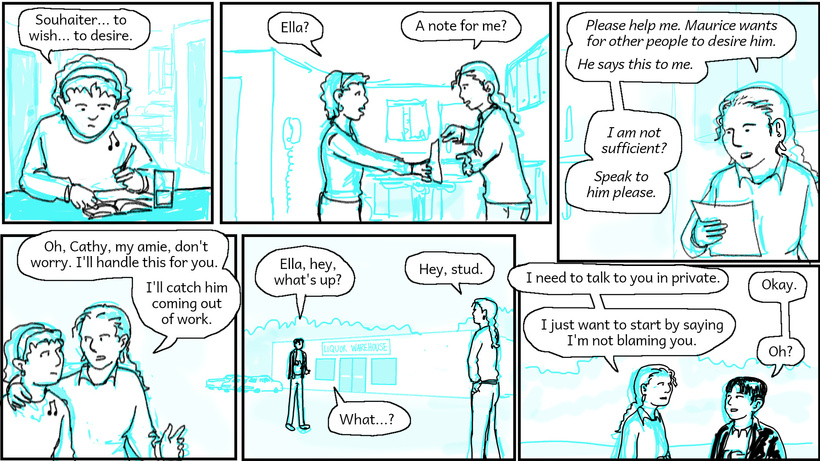
Cathy carefully composes a note in English, using her French-English dictionary. She presents it to Ella, who reads: "Please help me. Maurice wants for other people to desire him. He says this to me. I am not sufficient? Speak to him please."
Ella puts her arm around Cathy reassuringly. "Oh, Cathy, my amie, don't worry. I'll handle this for you. I'll catch him coming out of work."
She catches Maurice in the parking lot of Liquor Warehouse. "Hey, stud," she greets him, much to his confusion. "I need to talk to you in private."
"Okay," Maurice says.
"I just want to start by saying I'm not blaming you," says Ella.
"Oh?" Maurice looks a little bit alarmed.
***
My friend whose Gofundme I posted a few days ago is in a dire situation. The fundraiser isn't going to hit its goal. Her house got foreclosed on, her car was repossessed, she has two kids including one who has socio-emotional disabilities even in secure times, and she has 5 rescue cats that she is determined to hold onto because they're all difficult cases. I ran out of ways to help her, and I feel terrible. I wish I had a place to let her crash temporarily, but we have a full house here, and we can't allow the cats because Typhoon is vicious and horrible with other cats - we already tried twice to take in other cats and it didn't work. (I don't need advice on that front - I'm very experienced in cats with behavior problems and the rescue thereof, and it's just the layout of this house plus Typhoon being a Force of Nature with no 'off' button.)
I'm backing off from bothering my friend with my half-baked ideas, but I feel rotten about it. Her survival plan is not perfect, but it might have worked before all her assets were taken from her.
Life is tough all around. We'll all be affected in some way or other, some more profoundly than others.
I could not get that toasted uncrustable out of my head so I decided to have it for lunch today after all - or at least try it and put the idea out of my misery.
From freezer - 3 on my toaster - to me. Chef's Fucking Kiss!! It's my new thing. Never again will I eat a raw Uncrustable. Toasted for me from now on and that also solves the problem of I want one, but they are all frozen.
This is big. Very big. This was grape jelly. I think there's a honey one in the bottom of the freezer, that would be maybe even better!!!!
Laundry done and put away. Pockets sewn on two robes that were slated for the bin because their pockets were not useable. They are not really robes - they are long zipper hoodies. Really old but since they are used to walk through the parking garage to the pool, I don't care.
Jim Across The Hall got his haircut and a shave this morning and he was so excited, he rang my doorbell to show me. It does look nice.
It's the other Jim's birthday tomorrow and his girlfriend is baking a cake - it's the same cake he has every year and he brought it to elbow coffee last year and it was soooooooo good. So tomorrow we are having cake!
Hello to all members, passers-by, curious onlookers, and shy lurkers, and welcome to our regular daily check-in post. Just leave a comment below to let us know how your current projects are progressing, or even if they're not.
Checking in is NOT compulsory, check in as often or as seldom as you want, this community isn't about pressure it's about encouragement, motivation, and support. Crafting is meant to be fun, and what's more fun than sharing achievements and seeing the wonderful things everyone else is creating?
There may also occasionally be questions, but again you don't have to answer them, they're just a way of getting to know each other a bit better.
This Week's Question: What is your favourite thing to make?
If anyone has any questions of their own about the community, or suggestions for tags, questions to be asked on the check-in posts, or if anyone is interested in playing check-in host for a week here on the community, which would entail putting up the daily check-in posts and responding to comments, go to the Questions & Suggestions post and leave a comment.
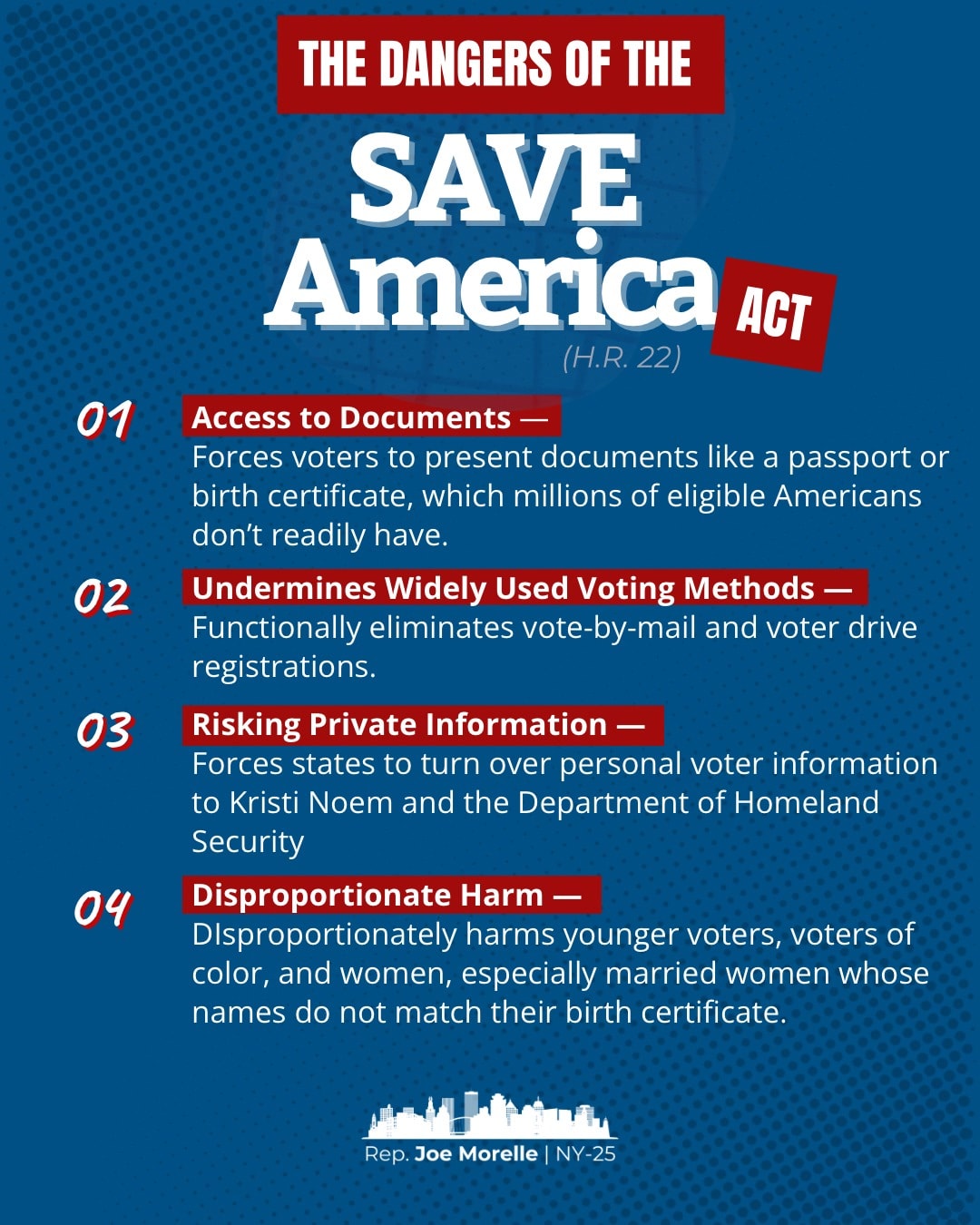
So, I know we’ve had a real escalation in voter-suppression talk from the Trump regime this week. Yesterday the Washington Post published a report about an “emergency” Executive Order Trump is rumored to be considering that would give him SAVE-Act-like powers. (Powers he doesn’t, by the way, have.) Republicans are still considering the SAVE America Act. Scary stories about election interference, in general, abound.
Here’s the thing. As other have since said, the Trump administration WILL LOSE IN COURT on his IEPPA-based emergency EO. He will. Marc Elias is calling the idea “blatantly illegal,” and he’s far from alone. I can’t find a single serious legal expert who thinks Trump will succeed with it. Does he want to? Yes. CAN he? That is an entirely different question. And the answer is: no.
Now on the SAVE Act and its various iterations: John Thune said again this week that he doesn’t have the votes to change the filibuster for this bill—even to a talking filibuster. He said it’s not happening right now. But he still plans on bringing the so-called SAVE America Act (better known as the “End Our Votes Act”) up for a vote. It will be filibustered and fail. So he is essentially saying he plans to kill it.
In fact, there is a direct correlation between his recent statements and the fact that the regime has now leaked this EO idea. They are desperate. Knowing that their voter suppression bill likely won’t pass in time to help them—if it even would—they are pivoting to plan B (actually, we’re much further into the alphabet than that).
This regime, in short, is frantically throwing everything they can at the wall. Nothing is sticking. So they throw more. The simple truth is this: they want to keep people from voting so they can control our elections and seize more power. But that doesn’t mean they get to.
As my friend Robert Hubbell says all the time “we are not potted plants.” We have agency. We have power. We have the best lawyers in the country (I’ll have one of them on my Substack Live on Monday). We have Democratic Attorneys General already planning responses to attacks on our elections (I am going to have one of them on my Substack Live the following Monday). We have the courts.
We have the vast majority of Americans.
And I mean that! Most Americans want every voter to vote and every vote cast to be counted. There are many, many more of us than the tiny minority who want to stop us from voting. We, not they, will prevail. We will decide our future. We will choose our leaders. We will ensure the will of the people prevails.
What happens next is up to us, so here’s what we’re going to do. We are going to show up, speak out and refuse to be intimidated. Every eligible voter should have an equal say in the decisions that impact our lives, and we’re going to make sure they do. We will come together across races, places and parties to demand free and democratic elections.
WE CAN DO THIS.
It’s going to be a challenging—heck, brutal—eight months. Trump is terrified. He’s a weak, scrambling, mentally incoherent failure. His schtick is no longer working—his SOTU was, beyond all other things, boring. He is looking increasingly guilty as far as the Epstein files go; members of his administration are, too. His economy is failing, badly. Americans are abandoning him in large numbers. The largest single-day protest in American history is a month away. ICE and Border Patrol are still killing people and harming children, infuriating and disgusting decent Americans. His admnistration’s incompetence continues to make headlines. The Democrats have a ten point lead on the generic Congressional ballot—crazy!
He is losing. He is going to do everything he can to stop it, but that doesn’t mean he’s going to succeed. Because we are not going to let him.
Channel your inner defiance, y’all. Trump can’t take our elections away unless we let him. We won’t. We will fight him tooth and nail every hour of every day, and we will win. Never believe otherwise.
Trump is not a deity. He has no superhuman properties. He’s a sick, sad, small geriatric man whose influence and power are waning.
Ours is growing. Know it. Embrace it. Project it.
Every child in this country is counting on us. Every Epstein victim is, too. Every marginalized person, every immigrant, every transgender person, every woman, every person with disabilities, every American struggling to get by…all of them need us to be strong right now. So let’s be strong, and let’s get to work. And if you don’t feel particularly strong that’s OK. We can act strong without feeling it, and it is in so doing, ironically, that we build strength we can feel.
I love you. This is hard. Let’s keep going.
P.S. — if none of this does it for you read Josh Marshall’s clear-eyed and appropriately pugilistic response to Trump’s “Fake Executive Order” here.
Hi, I’m a constituent calling from [zip]. My name is ______.
I want the Senator to vote NO on the SAVE America Act, a bill that would suppress the vote of women, Black and Brown Americans, and young people, and cause chaos in our elections.
[If GOP add:] There is zero evidence that non-citizen voting happens in a statistically meaningful way and all the evidence in the world that Republicans’ policies are unpopular and they’re simply afraid they’re going to lose the midterms without this voter suppression bill. A political party tries to court your vote. An authoritarian regime tries to keep you from voting. Shame on Republicans for doing the latter instead of the former.
Also, the DOJ is engaged in a coverup on the Epstein files. We want to see ALL of the files—unredacted aside from victim information—and we want Trump to testify under oath about the 13-year-old he is accused of sexually assaulting.
Finally, the American people DO NOT want another endless war in the Middle East. I’m counting on you to do everything in your power to stand up to Trump and stop further military escalation in Iran. Thanks.
Hi, I’m a constituent calling from [zip]. My name is _______.
First, the DOJ is engaged in a coverup on the Epstein files. We want to see ALL of the files—unredacted aside from victim information—and we want Trump to testify under oath about the 13-year-old he is accused of sexually assaulting.
Second, I want the Congressmember to oppose any legislation that shields the producers of pesticides from liability and allows dangerous chemical like glyphosate to be spread into our food supply. Additionally, I ask him/her to support the bipartisan “No Immunity for Glyphosate Act" to block federal funding for this executive order. Thanks. [H/T]
Finally, the American people DO NOT want another endless war in the Middle East. I’m counting on you to do everything in your power to stand up to Trump and stop further military escalation in Iran. Thanks.
Extra Credit ✅
Byron Javier Martinez Kuvi is in ICE detention in Michigan. He has a serious abscess in his mouth causing severe swelling and pain. He began seeking medical attention days ago. After repeatedly asking for help, he was finally taken to medical where he was given only ibuprofen and sent back. No antibiotics. No proper treatment.
An untreated abscess can quickly become life threatening. He needs immediate medical care.
People often ask me where I get my news in such a fractured and unreliable media atmosphere. As I’ve said here before, my go-to is Ground News. I love them so much that I’m partnering with them, because I think it’s REALLY important—in fact it’s never been more so—to see who’s behind the news we’re reading and how their biases affect the story.
Ground News not only gives me all the current news stories and shows me coverage of them from across the ideological spectrum, but it does other cool stuff, like point out stories that are in my personal blind spot:
And bias distribution on every single news story:
I love it—it makes me feel like a smarter news consumer. Anyway. If you’re looking for a new way to read the news with tons of data about the bias and partisan leanings of the publications you’re reading, Ground News is awesome. You can get 40% off a Vantage Plan subscription through my link. I DO NOT GET PAID PER SUBSCRIPTION so don’t do it on my behalf. But I do think it’s a great news source and it does force me to see news I otherwise would never encounter. This is sometimes a good thing, sometimes a depressing one—but always necessary to be fully informed.
The folks at Detention Watch Network have an incredible toolkit you can use to take lawful and nonviolent action to fight ICE warehouse expansion. Find it here.
Then check out this map to find possible detention center expansion near you. The map was created by , which seems like a good resource for fighting ICE also!
Messaging! Messaging! Messaging! 📣
DemCast is doing a social storm today about the SAVE Act. If you want to help amplify the danger this bill poses and push people to call their Senators, please use this toolkit to do so! It’s got posts and suggested captions for every conceivable platform. Don’t like the caption? Edit it! Like it? Keep it as is!
Give 💰!
Worried about 2026? There’s hope! The path to a 2026 Blue Wave runs through college campuses. Join Senator Chris Murphy and Donuts + Democracy on Tuesday, Mar 3 at 4:00 PM PT / 7PM ET to learn how they’re already mobilizing young voters and protecting against election interference with young voters and organizers across the country.
This International Women’s Day, Women’s March is calling for a national weekend of direct action, March 7–9. We are done waiting for justice while powerful men are protected and the truth about Jeffrey Epstein stays buried.
We will center survivors. We will demand full transparency. We will organize against every system that shields abusers like Jeffrey Epstein and every person in his client list.
A small thing we can do if we are AI subscribers is move our business away from Chat GPT and TO Claude. Claude’s parent company Anthropic is standing up to the Trump admin in a big way and that is huge! The company behind Chat GPT is super Trump aligned anyway—we’re supposed to have unsubscribed from them per Resist and Unsubscribe. But this might be a time to actively support a company with our dollars just to thank them. I know I am.
Resistbot Letter (new to Resistbot? Go here! And then here.) 💻
(Note that for the most effective RESISTBOT it’s best to personalize this text. More about how to do this here. But if you’re short on time just send it as is using the above code.)
The Supremacy Clause of the United States Constitution establishes that valid federal law is the “supreme Law of the Land.” When federal and state law conflict, federal law prevails.
It does not require states to finance, facilitate, or expand federal enforcement infrastructure.
Under long-standing Supreme Court precedent, the federal government may not “commandeer” state governments to carry out federal programs. This anti-commandeering doctrine protects state sovereignty by ensuring that federal authority does not become a mandate for state participation.
Immigration and Customs Enforcement (ICE) is a federal agency. If ICE seeks to expand detention capacity, that responsibility lies with Congress and the federal executive branch.
States are not obligated to: • Provide land or public facilities • Enter into detention contracts • Allocate state funds • Grant discretionary permits or zoning approvals • Supply state or local personnel
The Supremacy Clause prevents states from obstructing lawful federal operations. It does not compel them to subsidize them.
A couple of Sundays ago (Feb 1) I was lying in bed and I had an itch on my foot. I pulled back the blanket and reached towards my ankle when I noticed the big toe on my right foot was huge. It had a pus sack about a half inch wide, the full length of my toe. Upon further inspection, I saw all four other toes were blistered to differing degrees. My left foot was the same though the big toe sack was considerably smaller . As I inspected my big toe the damn pus sack popped and oozed out all over my foot. It left a lot of loose skin. Over the day it refilled itself a little, but not to the same degree as the morning. I kept an eye on it and decided to go to the local orthopedic emergency service Monday.
We went the next morning and before we even broached the subject of my feet the doctor went over a bunch of things in my medical history that was news to me. Apparently there were some things going on that my general practitioner never mentioned. There were issues with my vitamin B and D3 being low. Issues with hemoglobin, issues with diabetes, issues with cardiovascular routines. I walked out of their sicker than I entered. Eventually, we made it to the issue at foot. Looked to be an aggressive bacteria. It came, it damaged, it left. I was currently free of the actual toxin, but it was too late. Dr. That Elizabeth wrapped my feet up and made appointments to go to the wound care clinic.
Stay tuned for chapter 2 of "Where Stupidity & Idiocy Collide". Coming soon to an LJ near you!!
![[personal profile]](https://www.dreamwidth.org/img/silk/identity/user.png) kaberett
kaberett

![[syndicated profile]](https://www.dreamwidth.org/img/silk/identity/feed.png)




![[community profile]](https://www.dreamwidth.org/img/silk/identity/community.png)